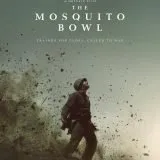



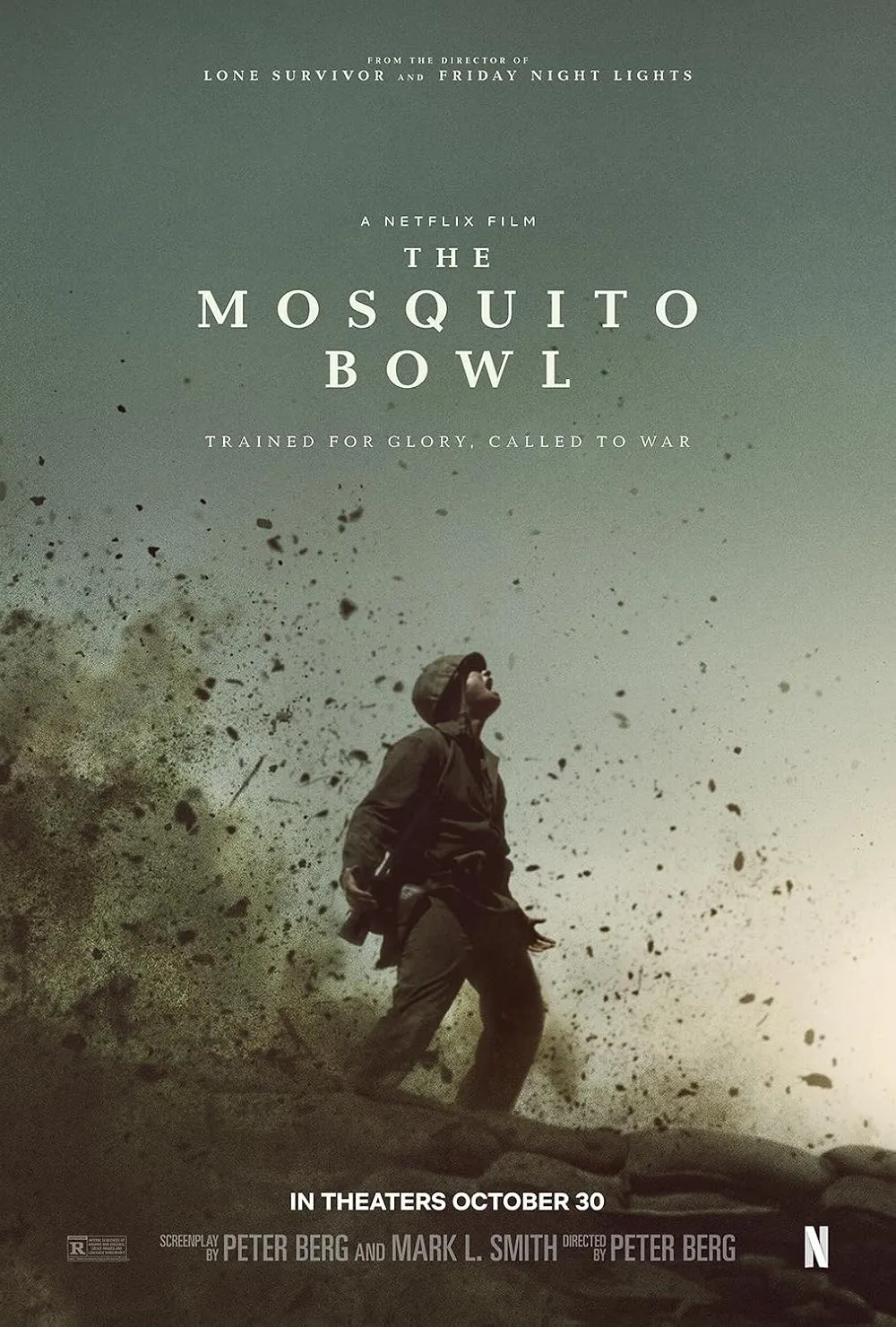
The Mosquito Bowl opens just before World War II, with sepia-toned football and apple-pie Americana. It’s that innocent time when nothing is bigger and more important than a college football rivalry. When missing a tackle feels like the end of everything. When a football star’s girlfriend seductively laments, from the bathtub, that she wishes she could feel the magic that he does while playing. The closest she gets to that feeling, she purrs, is when he is inside her, “pouring all that heat” into her. Ew.
Thankfully for viewers, the war starts, and games are pushed aside. Four of the football players who were hastily introduced in the opening scenes enlist, go through basic training, and are then whisked off to the Pacific to fight. They’re all white boys, and the very thin character sketches make it difficult to tell them apart. Eventually, we come to sort of know them by a few characteristics (if not actual character).
Butkovich is the easiest. Ray Nicholson plays him with effortless cockiness (just like his dad Jack), making the biggest impression as a star football player with talent to match his swagger. Less memorable are the token aw-shucks, drawling country boy Bauman (Bill Skarsgård), the grumpy and quiet Schreiner (Tom Francis), and finally the pretty and vacant McLaughry (Nicholas Galitzine), the dull young man from the earlier bathtub scene. Unfortunately, the dullard McLaughry is given the most screen time.
Where The Mosquito Bowl stumbles in its storytelling and character development, it goes all-out in its battle sequences. Director Peter Berg does not skimp on showing the viewer the full terror of combat as these young men face bloodshed first at Tarawa and eventually in the brutal and devastating Battle of Iwo Jima, where so many lives were lost. It’s hard to praise a film showing such violence, but these moments are truly visceral and horrifying. If that is what you hope for in a war film, The Mosquito Bowl delivers.
But what about the title? The bowl it refers to is a good-natured Christmas Eve football game, meant to boost morale before the men are sent off to a battle from which many would never return. This moment is full of joy and youth and brings a bit of light back to the eyes of soldiers who, at that point, had already experienced things that no one should ever have to. It’s a nice moment in a film that is otherwise very, very heavy.
Beyond the expertly staged battle scenes, Berg is a bit wobbly in his filmmaking. Some moments are surprisingly lovely, like when the soldiers see the beauty of a breaching humpback whale next to their warship, or when the men, stripped of their uniforms, wade into the tropical surf to let the water cleanse their scarred bodies. But then there are several transitions featuring views of Earth from space, I suppose to emphasize the insignificance of humanity in the big picture. It’s an awkward artistic choice that falls flat, so of course it is done multiple times.
Even though you barely get a chance to know the characters, it’s hard not to be moved by The Mosquito Bowl. These young, beautiful men are sent off to fight as pawns by world leaders. When their journey culminates at Iwo Jima, you just know it will be the final battle for many of them. If the storytelling doesn’t quite deserve the emotional response it’s reaching for, the skillfully staged final battle still ends up getting you.