


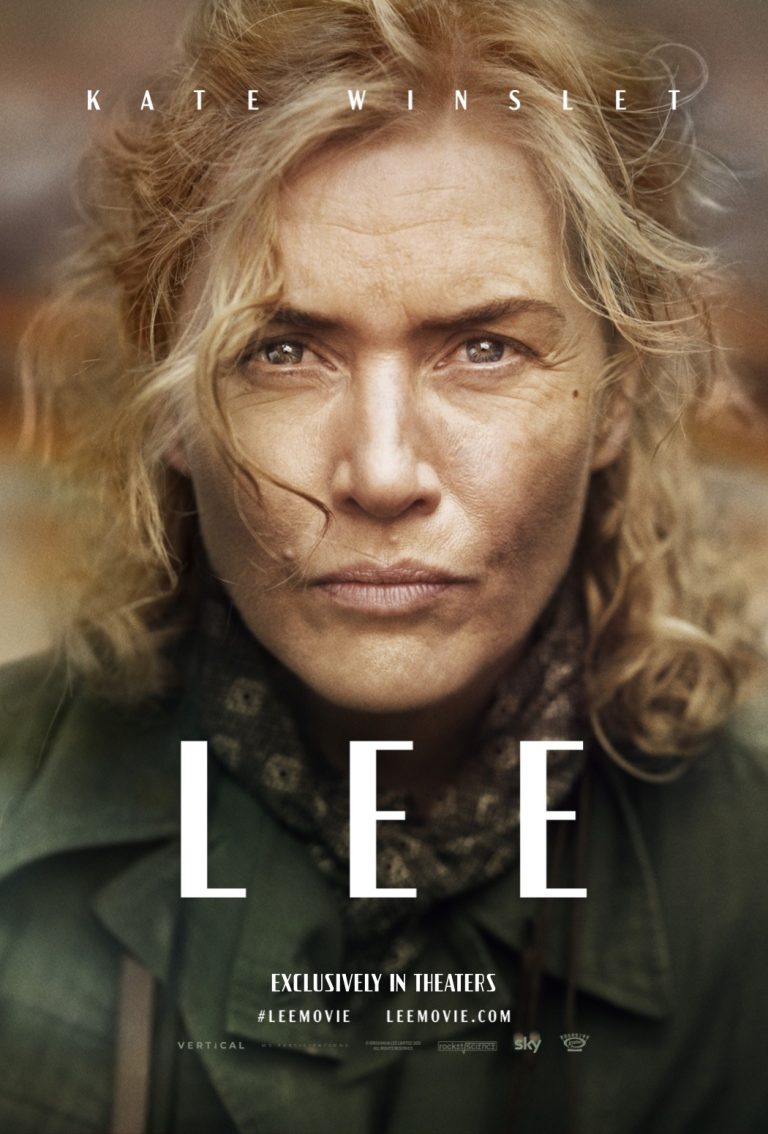
At first glance, Lee is a somewhat formulaic biopic centered on one person’s experiences during the horrors of World War II… but the film wastes little time establishing that this character is looking at war through a unique lens. This lens is the camera of American war photographer Lee Miller (Kate Winslet), a woman who now is regarded as one of the pre-eminent documenters of the horrors of WWII. The film focuses the years just before and during WWII, when she fought to participate in the war cause as a photo journalist, got what she wanted, and ultimately (unsurprisingly) carried baggage full of demons with her for the rest of her life.
We first meet Lee in a more carefree time in the late 1930s, whipping off her top as she lolls in the French countryside with her gaggle of artist and intellectual friends. This brief moment establishes a) the day she met her longtime love Roland Penrose (Alexander Skarsgård), b) that she was already an established photographer in her own right, and c) that she and her friends were well aware of Hitler, but still surprised at how quickly he established such massive power. Cut ahead a couple years: the war has begun, Lee and Roland are now living in London (he’s a conscientious objector), their friends are stuck in now-occupied Paris, and she is chomping at the bit to help the effort as a photographer.
British Vogue‘s editor Audrey Withers (the great Andrea Riseborough) takes a chance on her photo-journalism pitch (British woman are participating in the war cause, after all) and Lee finally gets her foot in the door as an embedded photographer with the Americans. But she quickly finds out that there is no intention to send her to the front, in fact she is often not even allowed in men’s-only spaces, much to her frustration. This slowly changes as the war drags on, but it also gives Lee the opportunity to see and photograph what her male counterparts don’t see… the private quarters of British women pilots, for instance, or a shelter of women and children cowering not just in fear of bombs, but of male soldiers.
Kate Winslet is always great, and her Lee is gritty, grim, and (we soon learn) haunted… seeing ghosts of her own buried past reflected in the many frightened, abused, and discarded women and girls that she meets. Lee’s right-hand man is Davy Scherman, a photographer from Life magazine, played nicely by Adam Sandberg in a rare dramatic role. He really gets to shine when their stint together culminates in the famous/infamous photo that he takes of Lee in Hitler’s bathtub at the end of the war. The scene is surreal after all of the destruction they’ve witnessed, and she (thinking as an artist) sees a unique photo opportunity. But for Davy, the moment ultimately (and unsurprisingly) breaks him.
If you do any small amount of Googling, it’s clear that Lee Miller had an interesting and unusual life before and after the events depicted in the film. Lee chooses to skip over all of that except for “modern” (1970s) awkwardly-inserted scenes where an older Miller confrontationally chain-smokes and drinks her way through an interview with a young man (Josh O’Connor). This framing device (beyond a hasty last-minute twist) doesn’t offer much to the narrative, other than showing that the woman obviously suffered from PTSD for the rest of her life. But if films like this introduce us to fascinating and groundbreaking women like Lee Miller who many otherwise be not given their due, I’m certainly here to support them.