



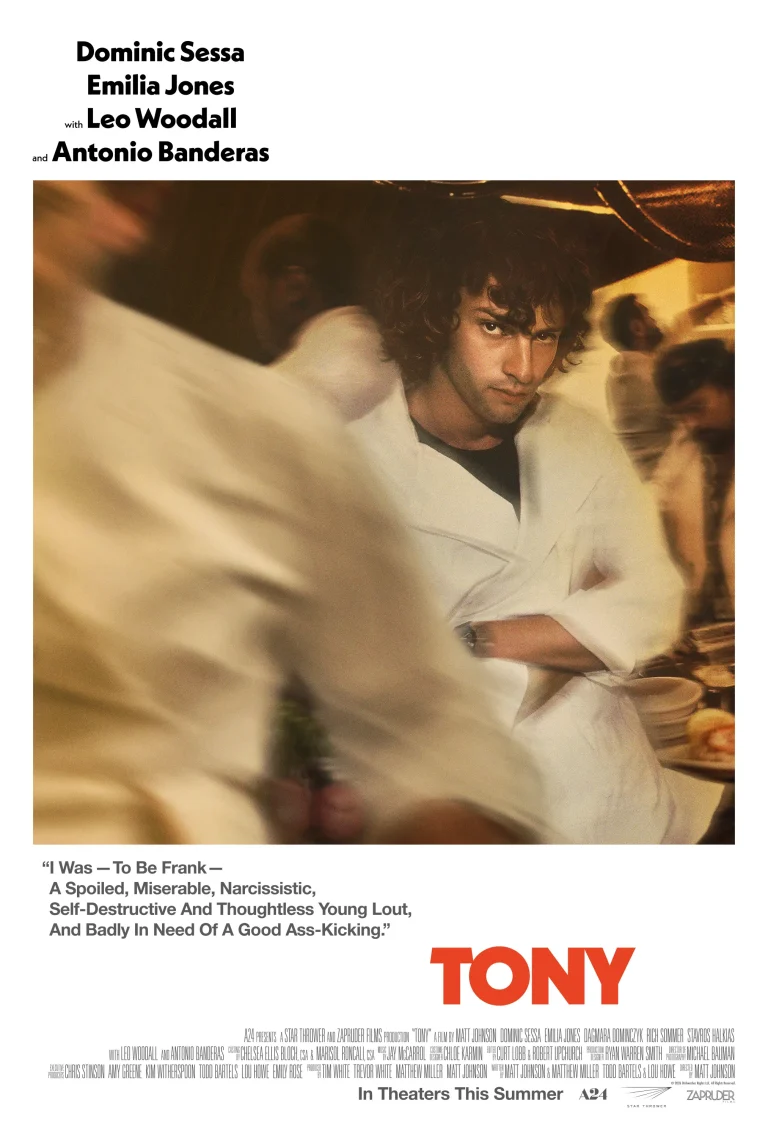
What perhaps is most surprising about Tony, a coming-of-age story about a summer in the life of future chef, travel writer, and TV host Anthony Bourdain, is how little it leans into his eventual legend. Instead, Tony is a broadly appealing coming-of-age film about a cocky, aimless college student whose spontaneous choice one summer ends up completely altering the trajectory of his life.
Tony (Dominic Sessa) is a shaggy, lanky guy brimming with that sort of overly intellectual white-boy overconfidence that has served him well, bullshitting his way through college. When he finds out that he didn’t get a writing fellowship that he was so certain would be his ticket to an easy summer break, he reels. In a spontaneous decision, spurred no doubt by the promise of a stifling summer at home facing his sees-through-everything mother, he goes to Provincetown, following the summer plans of his high school crush Nancy (Emilia Jones).
His inherent cockiness only goes so far in a small tourist town. A black eye and a bruised ego later, Tony finds himself needing to work off drunken-night damages at a touristy seafood restaurant run by a dedicated chef (Antonio Banderas) who is short a dishwasher for the season. Thrust into the chaotic, crass kitchen with the likes of a swaggering, coke-snorting lothario (Leo Woodall) and wisecracking prep cook (Stavros Halkias), Tony finds himself in a situation where if he doesn’t learn fast, he could literally lose a finger. Tony spends his summer sleeping on his boss’ deck and working off his debts, while his self-image as a writer is slowly worn down by a genuine, burgeoning interest in the kitchen.
One thing I immediately loved about Tony is its sense of place in a town that explodes with tourists during the summer, then retreats into a locals-only vibe as soon as the guests leave. The locals lament the traditions and character being lost even as they depend on the brief summer crowds for their livelihood. Meanwhile, the seasonal workers bring their own transient liveliness to the town, with their live-in-the-moment mayhem of partying and hooking up keeping the whole town humming for its peak season.
Dominic Sessa’s Tony is engaging enough to never become completely super-douchey, and eventually humble enough to realize that listening to others—most notably Chef—might open up his world in unexpected directions. He literally takes a beating and actually learns from it. One of the more amusing moments has Tony trying to impress Nancy with an aphrodisiac oyster, despite not actually having paid attention in the kitchen to see how it’s opened. Needless to say, the butchered shell fails in its seduction. Determined and a little humiliated, he goes back to the kitchen to learn how to do it properly.
If anything doesn’t really click in the highly watchable Tony, it’s the love-interest subplot. Nancy is never truly developed enough to show why Tony was in such hot pursuit. Emilia Jones does what she can with the role, and Nancy is strong-willed enough to draw a line as Tony’s constant lies start to pile up around him. But her presence feels more like a plot device, even though her real role in Bourdain’s life was much more interesting.
What does click is Antonio Banderas. He can say more with a look over his glasses in the kitchen than even the most withering librarian could, and he’s the absolute soul of the movie. He brings the warmth of a life fully lived, playing a man who once tasted greater success in his field but ultimately found a comfortable, if slightly stagnant, life in a small tourist town. Part of you wants to scream at Tony to stay after the summer, to keep learning from this man. But Chef is a wonderful representation of the kind of person who enters your life almost by chance, only to leave you seeing the world in a completely different way.
Intriguingly, the postscript for Tony only hints at the eventual culinary and pop culture impact of Anthony Bourdain, which is why this film ends up being a surprisingly universal and resonant coming-of-age film. It works as a sort of Chapter One introduction to a famous person’s life, but succeeds even better as a stand-alone story of one young man growing, learning, and unexpectedly discovering a path that feels like his own.