


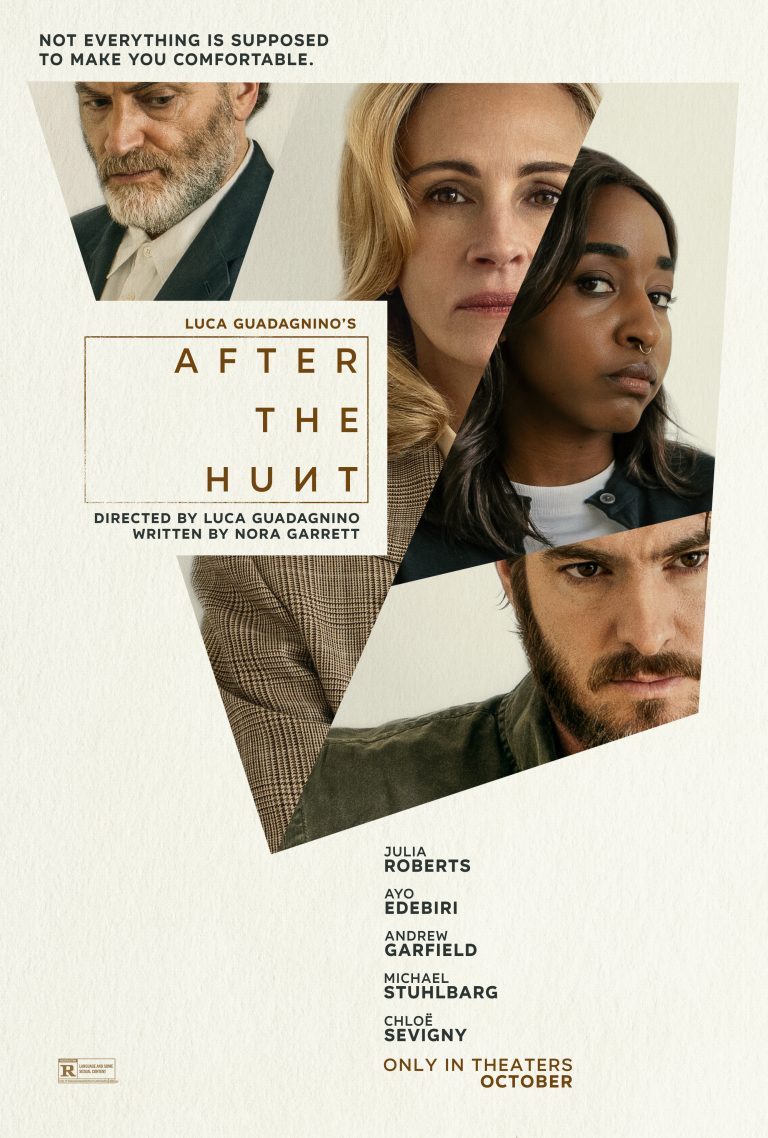
Luca Guadagnino’s After the Hunt efficiently introduces the main players of this entangled, moralistically murky tale. We are dropped into any Ivy League house party hosted in a professor’s home, where pseudo-intellectual banter flows as copiously as the booze. Inhibitions are lowered, bodies casually drape over each other on crowded couches, and eyebrows are only vaguely raised at potential inappropriateness that may lead to next-day embarrassment.
But lines are apparently crossed after everyone staggers away from the gathering hosted by Philosophy professor Alma and her psychiatrist husband Frederick (Julia Roberts and Michael Stulbarg). The following day, Maggie (Ayo Edebiri), Alma’s protégé PhD student, accuses another professor Hank (Andrew Garfield) of “crossing the line” after he escorted her home and they had a nightcap together. The accusation is shocking, so we as viewers are a little surprised by Alma’s hesitant reaction. Alma physically retreats as Maggie reaches for comfort.
This is where After the Hunt throws everything and the kitchen sink into the backstory of the characters to illustrate that things are never as simple as they seem. Hank and Alma, after all, share a flirty intimacy beyond just mere colleagues, plus it has been made very clear that they are both battling to be selected for tenure in their Philosophy department. If Alma “sides” with Maggie, it could be seen as an attempt to derail Hank’s chances. If she holds back, she is not supporting a vulnerable female student in the very male world of academia. Oh, and Maggie is also gay and black… but her rich family donates tons of money to the school. So, is she marginalized or entitled? Is Hank (who proclaims innocence) the actual victim because he claims he’s being blackmailed for accusing Maggie of plagiarizing? And why is Alma acting so weird in all of this?
Indeed the film is pretentious because the characters are pretentious. These are folks that think they can intellectualize their way out of a complicated or murky situation just by pronouncing their point of view with conviction. Anyone from the outside looking at their actions would immediately say, “Well, that is a very bad idea…” despite their defense, of, “Yes, but what if…?”
The soundtrack by Trent Reznor and Atticus Finch has a spare urgency (a repeated motif is the tick tick tick of a clock), and the intimacy of the filming style—faces, glances, hands—lends to the intense claustrophobia of the story, especially as Alma and her own hot mess of a situation becomes the focus. Julia Roberts, it must be said, is fantastic here. Alma can be strangely steely and brittle, but when she turns on her magnetic charm, there is still something in her that will shut off immediately if you cross her boundary. Also, whoever designed Alma’s fashion sense of oversize blazers and flowing trousers, well, she looks amazing. At one point, it’s mentioned that Maggie has even started to dress like her idol, either out of reverence or else full-on crush.
Guadagnino (with screenwriter Nora Garrett) seems to be intentionally pushing buttons, showing all questionable sides of cancel culture and the #MeToo movement, down to the deliberate choice of mimicking Woody Allen’s default opening credit font and style (yowch). All of the characters are unreliable narrators, and no one emerges looking good in this hot mess. Is this supposed to be a snarky expose of the cancel culture gone amok? Or just a portrayal of a single case where no one involved can truly be trusted? If the latter (which I hope), then After the Hunt is a gripping, well acted drama of regular people making poor choices. If the former, than I agree that it can be seen as cynical dismissal of a movement that exposed a lot of horrifying behavior. It’s a potentially polarizing movie for these polarizing times.