


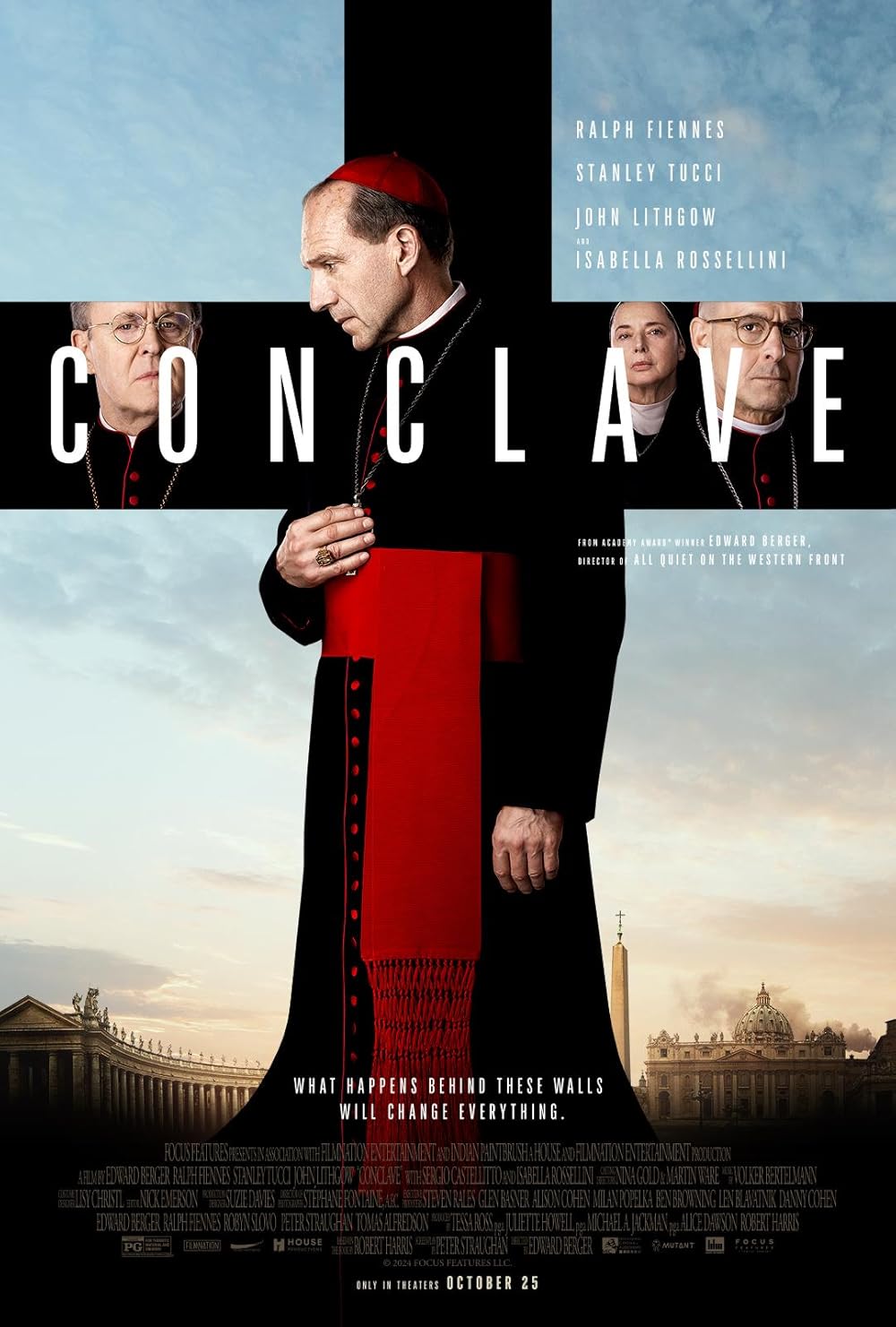
Richard Harris’s 2016 page-turner novel is now a cinematic papal thriller that is more timely and will probably be more polarizing than I’m sure he could have imagined.
The film wastes no time with the opening shot as Cardinal Lawrence (Ralph Fiennes, the soul and steady conscience of the film) is on the way to the Vatican, clutching his leather briefcase and his zucchetto (a small red skull cap). When he enters the private quarters, the pope, his dear friend, has already passed. An ominous stroke of violins over the soundtrack makes it almost seem that the pope’s abrupt passing may be of suspicious circumstances. But no, we are simply being warned that things are going to get very nasty very quickly as the order scrambles to elect a new leader.
Per the late pope’s wishes, Lawrence is appointed Dean of the papal conclave, the formal proceedings where the 100+ cardinals gather from around the world and sequester themselves in the Vatican to select the new pope. There are several immediate assumed frontrunners for the job, including cardinals Adeyemi (Lucian Msamati), who would be the first pope from Africa if chosen; Tremblay (John Lithgow) and Bellini (Stanley Tucci) from North America, with their more modern, progressive views; and Tedesco (Sergio Castellitto), an Italian who not only thinks the job should return to the homeland, but that the Catholic Church needs to dial back some 60 years of changes and return to strict tradition. A new, previously unknown cardinal named Benitez (Carlos Diehz) shows up at the last minute, surprising everyone and causing a stir. And even Lawrence himself finds his name murmured for the job, but claims he actually wants to back down from his higher stress appointments altogether and return to a quieter role.
The political machinations begin as soon as the men arrive. Low voices and furtive meetings hint at previously buried secrets and scandals. There is an urgency to the proceedings—including a terrorist threat just outside the walls of the Vatican—with information being discovered or revealed after each vote, causing the ballots to shift dramatically from one seemingly favored candidate to another.
I’m not exaggerating when I say that Conclave, for the most part, plays like an edge-of-your-seat political thriller in the juiciest way. The look of the film is breathtakingly gorgeous, each shot like a classical Italian painting, with the stark reds, whites, and blacks of the cardinals contrasting with marbled halls and the Sistine Chapel’s adorned walls and ceiling. The ensemble cast is uniformly top notch, which is no surprise when you have Fiennes, Lithgow, and Tucci sharing scenes (not to mention scene-stealing Isabella Rosselini, as a withering, no-shits-left-to-give nun who knows all the things, with her eyes narrowed and ears listening from the periphery of the boys’ club). Shots are often claustrophobic, focusing intimately on the bowed heads of two people whispering intensely. And props to the sound design for all the heavy nostril-breathing as the players inhale deeply and nervously as secrets are uncovered.
I liked Conclave so much that I was leaning toward a full-pie rating… right up until the final, final twist. The plot throws in one more zinger, just because it can… one that doesn’t really add to the already established point that there are indeed many things that need evolution of thought in the modern church. Despite not sticking the landing (I’m sure audiences will have strong opinions one way or another), I still think that Conclave is one of the most surprisingly entertaining, gripping, and well-acted films of the year.