


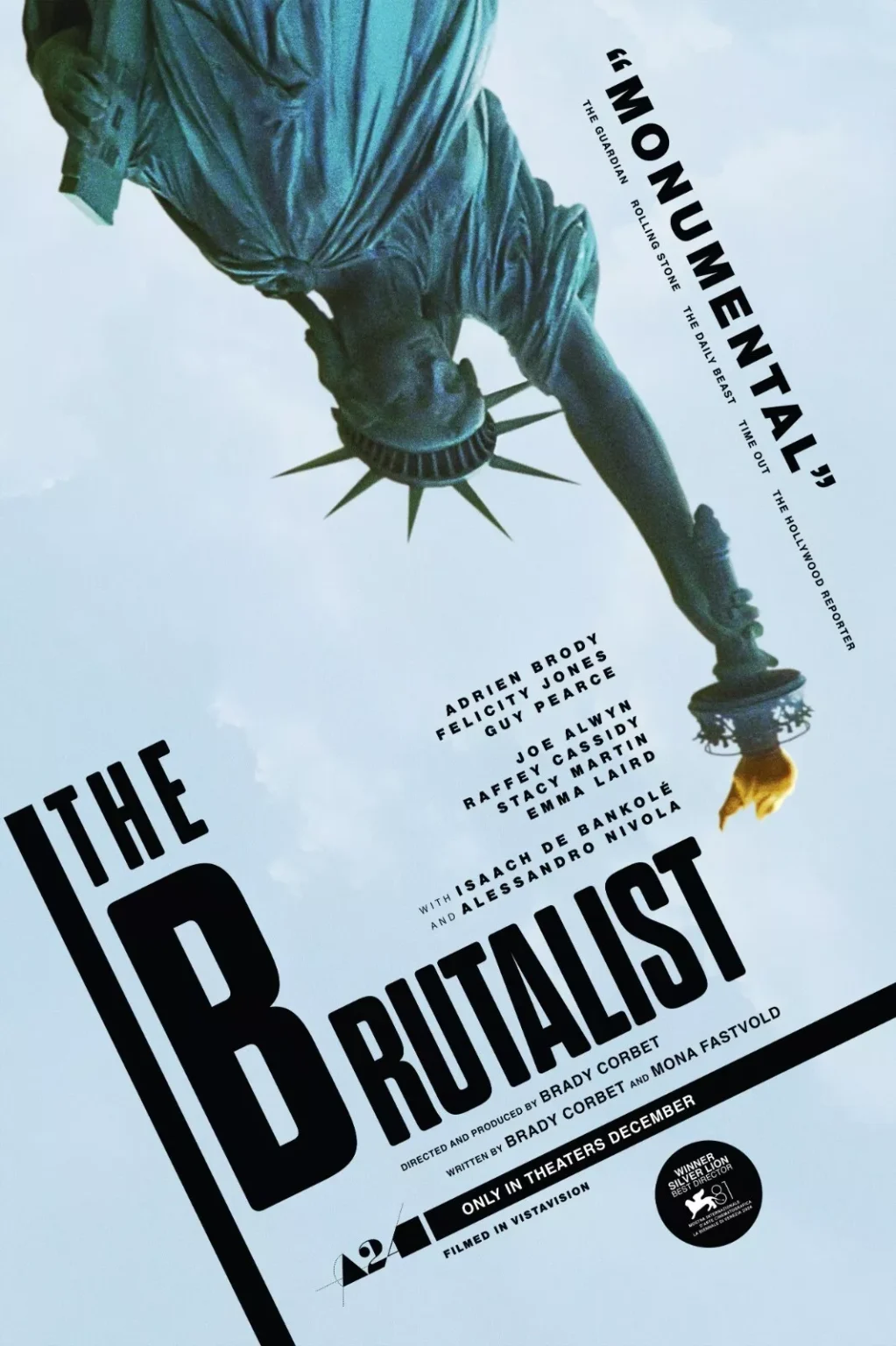
The opening shot of this rich, immersive, satisfying film is awash in darkness and confusion. It’s hard to see what is happening in the black chaos of voices, and knowing that this film is about a Holocaust survivor you instinctively think of the worst. But then the camera pushes its way into daylight and there’s the Statue of Liberty directly above. Upside-down in the viewer’s perspective, but triumphantly unmistakable. Hungarian immigrant László Toth (Adrien Brody) has emerged out of the crowded ship’s hull and arrived in America.
After a long bus ride to Philadelphia, László is met at the station by his cousin Attila (Alessandro Nivola). Weeping and laughing, the long-separated cousins embrace and caress each other’s faces in relief and disbelief. László is told that his wife Erzsébet is, in fact, still alive. It’s been two years since the end of the war, and this news is a miracle. The weeping and laughter begin anew—and the longer this scene goes on, the more deeply moving it becomes. The way director Brady Corbet gives this ordinary-yet-extraordinary moment room to breathe was my first sign that The Brutalist is something special.
A story about a Jewish Hungarian brutalist architect emigrating to the United States after World War II seems like an odd, years-long passion project for a 36-year-old director. But what a film. With a runtime of over 3-1/2 hours, including a built-in intermission, The Brutalist is a robust, epic piece of American filmmaking that could be shelved next to modern masterpieces of storytelling like Paul Thomas Anderson’s There Will Be Blood. It’s a warts-and-all portrayal of the immigrant experience that is both hopeful, distressing, and often infuriating.
Toth’s journey starts with him sleeping in the back of Attila’s furniture shop (named Miller & Sons, even though his name isn’t Miller, and he has no sons) where he designs modern-style furniture that mostly earns quizzical glances from the clientele. That is until the son of a wealthy industrialist commissions Toth to design a new library to surprise his father. The surprise does not go well (Toth is fired)… but try not to gasp as Toth explains then reveals the gloriously hidden bookshelves in Harrison Lee Van Buren’s sun-filled room.
As this IS an epic story, the industrialist Van Buren (Guy Pearce) comes around (after an architecture magazine showcases Toth’s brilliantly-designed library), finding the architect years later doing manual labor and living in a men’s shelter. Van Buren has a proposal: He want to commission Toth to realize his grand vision to create a cultural center that will be a centerpiece for his rural community. Van Buren wants a glorious piece of brutalist architecture that would be a monument to the community, but more importantly a monument to himself. Both men know that Toth can’t refuse the challenge and he accepts.
Toth is eventually joined by his wife Erzsébet (Felicity Jones) and niece Zsófia (Raffey Cassidy), but it’s refreshingly not a glossy, Hollywoodized reunion. Erzsébet is now disabled from her time in a concentration camp, and is furious that she will never be able to work again (well-educated, she was a journalist before the war), and Zsófia was rendered mute from her own wartime horrors. László himself deals with his own traumas with heroin. Yet they all have to be the “good” immigrants to keep in the good graces of their American patron. They know it, and Van Buren certainly knows it.
As the construction slogs on, years pass and the project takes its toll on all involved. Toth is routinely fired and rehired. Everything is over budget. Where there was once some mutual respect between Van Buren and Toth, their relationship evolves into something much more sinister. In their drive to see the building completed, both men are pushed to their own brinks of madness.
Adrien Brody easily give his best performance since his Oscar-winning role in The Pianist, and I would not be at all surprised to see him take home a second statue for this film. His László Toth is both broken and re-energized, haunted by the past yet forward-looking, wanting to leave his mark in a land in a country that has not particularly treated him well. Felicity Jones’ Erzsébet is fierce and full of understandable resentment. If the The Brutalist went on another hour (I would have easily watched more), I would have loved more of Erzsébet’s story. History is filled with strong women like her, who didn’t leave monuments in their wake but sacrificed so their men could do so.
But I have to admit, Guy Pearce almost stole the movie for me. His Van Buren is so groomed and deliberate that even his dialogue is spoken in crisp, complete, perfectly-formed sentences. My movie-going pal leaned over and whispered, “He talks like a novel!” And that’s exactly it. Van Buren feels like the perfect slow-burn villain leaping from the pages of a epic tome.
And perhaps that is why The Brutalist felt so immersive for me, despite, or rather because of it’s long runtime. It has gorgeous visuals, a propulsive, moving soundtrack, an involving, fresh storyline, and a stellar cast. It all adds up to the feeling of curling up with a good novel, letting the story unfold for deliciously uninterrupted hours, and sighing with a deep satisfaction when you get to the last page.