



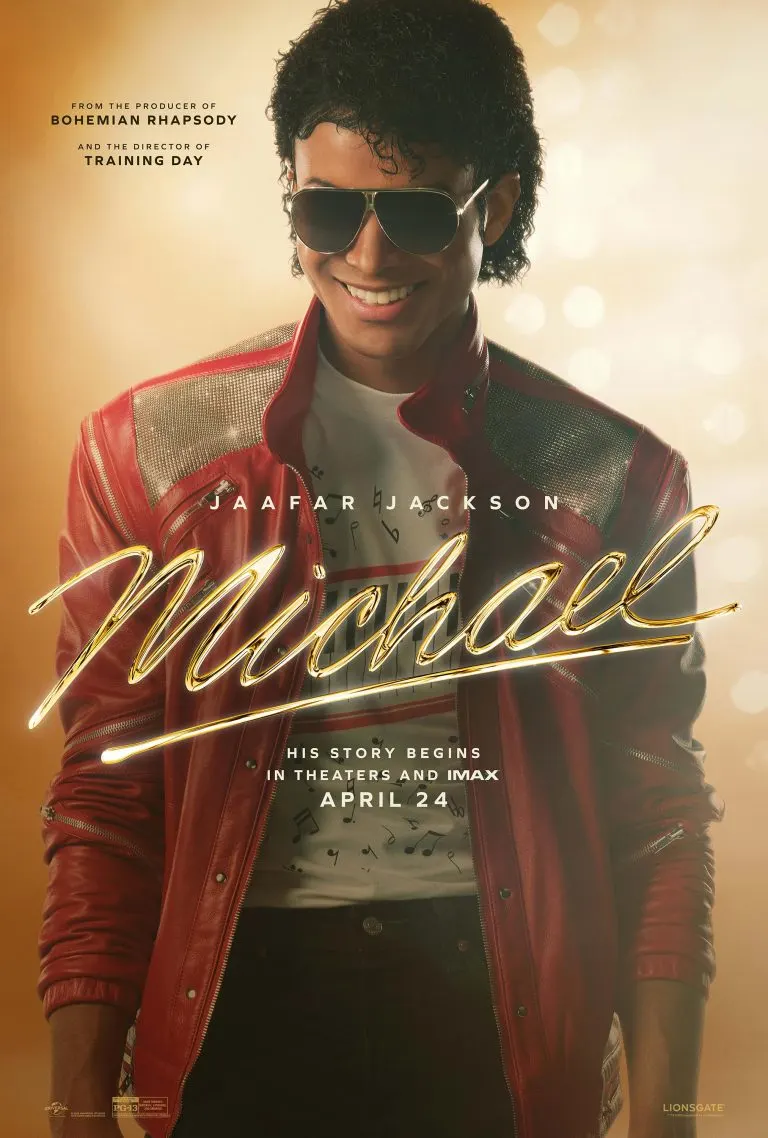
My skin tingled with anticipation as a remix of “Wanna Be Startin’ Something” stuttered over the spinning Universal logo. Like many fans, I was skeptical when I heard about yet another attempt at a biopic of Michael Jackson, the King of Pop. But with Antoine Fuqua (Training Day) directing and Graham King (Bohemian Rhapsody) producing, Michael came with a serious pedigree behind the camera.
There’s a tease of a moonwalk, followed by the back of late-1980s ponytailed Michael getting ready to go on stage—before the rush of adrenaline screeches to a halt, cutting to gray, dreary 1960s Gary, Indiana.
Joseph Jackson (the always-excellent Colman Domingo) is the patriarch of a clan of miscounted Jackson children (the film strangely omits two to three of the real-life siblings at any point). Joseph’s a bitter steel mill worker who has decided that his musically-talented boys will be the path to glory. They have the talent, especially little Michael (the terrific Juliano Krue Valdi), to be superstars, and with some discipline accentuated by beatings from his belt, Joseph will make it happen.
The first portion of Michael follows the Jackson 5’s rise as Joseph pushes them, eventually getting the attention from Motown Records. Michael notably can’t make eye contact with his father, and he hides in his world of imaginative stories like Peter Pan and The Wizard of Oz. But the boy absolutely blossoms when performing. If you can point to a “next best thing” to watching real footage of the Jackson 5, the musical recreations in the film are pretty great. (He just can’t, he just can’t, he just can’t control his feet in the recording booth leading to retakes of his vocals!)
Jarringly, the film leaps from the Jackson 5’s success straight to the late 70s (no mention of hits like “Dancing Machine,” “Blame it On the Boogie,” “Can You Feel It” etc.), when Michael (played by Jaafar Jackson, his real-life nephew), now an adult, decides (with fear of his father’s wrath) that he wants to make a solo record. The family is ensconced in their mansion in Encino, California, the brothers off playing basketball and dating girls, and Michael sees his chance to grow as an artist. But he is also still entirely under his father’s thumb.
The second half of Michael dutifully, chronologically follows Michael’s monstrous success through the 80s, from his breakout solo album Off the Wall to the stratospheric pop culture dominance of the best-selling album of all time, Thriller. In a delicious moment, Michael hires his own manager (Miles Teller) and has him fire Joseph via fax. Just when he is finding his feet, his overbearing father yanks him back into his orbit again, demanding that Michael share his Thriller success with his brothers by going on world tour as the Jacksons.
It’s clear that Michael Jackson’s family had a firm hand in shaping this first big-screen attempt to portray the King of Pop. Multiple Jacksons are listed as executive producers, but some are notably absent. It’s glaringly obvious, for instance, that superstar sister Janet Jackson wanted nothing to do with the film. Janet does not exist at all in the world of Michael. This omission isn’t just resoundingly strange; it’s emblematic of the film’s selectively constructed history. Younger brother Randy is never mentioned by name, or even acknowledged to exist, and neither is eldest sister Rebbie.
Michael also conveniently ends in 1988, which allows it to steer clear of mentioning the allegations of child abuse and the tabloid headlines that hounded Michael Jackson through the 90s until his death in 2009. The story wants to leave on a triumphant note, so I was struck by the final words on the film: His story continues. Well, that’s an understatement to say the least.
Is Michael revisionist history? Well, yes, certainly, in a way that it’s a surface-level introduction for those who know nothing about one of the most famous entertainers ever. We superficially get to know a sweet, childlike man whose only friends seem to be his exotic critters and his bodyguard (KeiLyn Durrel Jones). It kind of breaks your heart to see a twenty-something man excitedly buy the family party game Twister to play with his uninterested older brothers. But at the same time, nothing in Michael moved me the same way as, say, the Thriller sequence in the Broadway show MJ the Musical. Where the musical managed to portray the song “Thriller” as an emotional monster-metaphor for Michael’s personal demons, Michael takes the more literal route, reducing that complexity by pointing directly to Joseph as the singular villain.
While the movie leaves so much unexplored, it absolutely soars in the musical sequences. From charming recreated scenes of the Jackson 5’s performances, to Michael in the studio recording the initial vocals for “Don’t Stop Til You Get Enough” (to Quincy Jones’ amazement), to the electric Jacksons concert performance of “Human Nature”—the film’s musical moments are immersive in a way that the dutiful drama never is. The Motown 25 sequence in particular is astonishing, recreated down to the camera angles of the TV special (though I was a little disappointed it left out the white lady clapping off beat). Jaafar Jackson’s performance in those moments is thrillingly uncanny. But unfortunately the film around him never quite matches that dedication to truth.