


Though Steven Spielberg’s established his career with a series of great popcorn flicks (like Close Encounters, Jaws, and E.T.), but these days it seems he sleepwalks through his films unless it is a story he is clearly passionate about. Jurassic Park makes big bucks so he can make Saving Private Ryan. War of the Worlds makes enough money that he can make a controversial political thriller like Munich. If that is what it takes to let him do what he wants in Hollywood, why, more power to him!
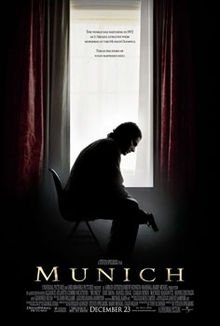
Based on the 1984 book Vengeance: The True Story of an Israeli Counter-Terrorist Team by George Jonas, about the aftermath of the massacre of Jewish athletes by Palestinian terrorists at the 1972 Munich Olympics, the film Munich dramatizes conjecture into plausible reality. At the beginning of the movie, the incident is unravelling on TV—the film using actual news footage, including ABC’s sportscaster Jim McKay’s televised reports—with regular folks around the world watching the drama unfold. When an attempted interception by German military goes very wrong, and all athletes are killed, Israeli Prime Minister Golda Meier appoints a team, led by her former bodyguard Avner (Eric Bana) to go to Europe and assassinate 11 men that are supposedly the Black September masterminds behind the Munich slaughter.
The group is a motley crew of seemingly unexceptional men, including Robert (Mathieu Kassovitz), a French toymaker-turned-bombmaker, Steve (Daniel Craig), a sexy badass whose main skill is driving the getaway car, Hans (Hanns Zischler), a German good at forging documents, and Carl (Ciaran Hinds), a conservative bookish looking fellow, who serves as the “cleaner” for the group, making sure that the crime scenes are untraceable. These men are not trained assassins—which is the main reason they were chosen: Who would suspect them?
Spielberg cranks up the tension, tracking these men from one job to another. There are genuinely thrilling moments in Munich involving some of the hits… especially when they don’t go as planned. Occasionally bombs are too powerful, or not powerful enough. When Avner and Robert are face-to-face with their first hit, a professorial-type holding bags of groceries in his apartment lobby, they are obviously terrified, and their guns shake in their hands. While humanizing these men and the passion behind their mission, Spielberg cleverly starts to show the questionable morality of some of their actions. As the film continues, the characters themselves start to break down, wondering the purpose of their continuing vengeful violence. They cut off the snake’s head only to see another grow back in its place.
Seeing Munich on a small screen, I couldn’t help but feel like it would work better as a big-screen experience. It is a pretty relentless story… the men are constantly on the move, and we follow from one hit to the next. When there are 11 men to kill cinematically, you start to wonder if they will be successful in finding them all, and if so, will the movie be six hours long. I won’t answer that, but suffice it to say, it does finally wrap up at almost three hours. Though not quite copping out with a schmaltzy out-of-place final act, as he often does, Spielberg does throw in a bizarrely uncomfortable final flashback of the event at the Olympics interspersed with, well, you’d have to see it.