



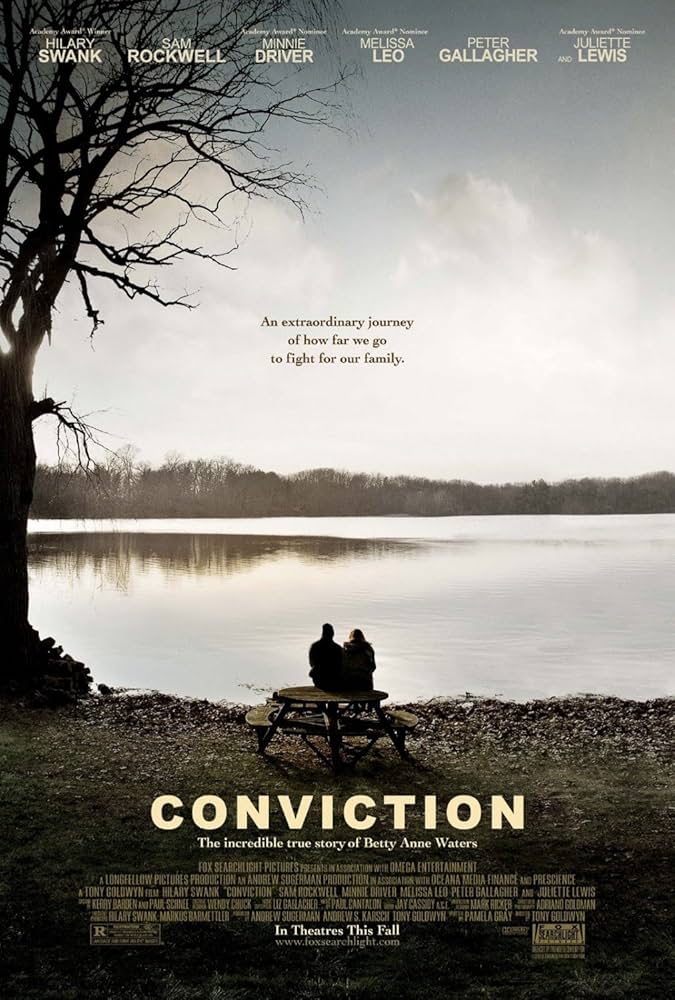
Hilary Swank stars as Betty Anne Waters, a blue-collar Massachusetts mother and housewife, who decides to get her G.E.D. and put herself through law school so she can become a lawyer and free her imprisoned older brother, Kenny (Sam Rockwell), who was wrongfully convicted of first-degree murder in the early 1980s and given a life sentence. The arduous journey from conviction to freedom, and battling a system that isn’t particularly interested in reexamining the closed case, takes 18 years, and its ups and downs form the basis for the film.
The film unfolds in an occasionally erratic fashion that sprinkles flashbacks around somewhat distractingly – unfortunately, the non-linear storytelling does nothing to serve the action, and often makes it more confusing. Not helping matters are the hair and make-up techniques used to indicate the passage of time which, in some cases, are very weak. While Melissa Leo’s dirty cop, Nancy Taylor, is wonderfully transformed, and Juliette Lewis’ trashiest-of-the-white-trash prosecution witness looks like she ages 30 years instead of 15, not everyone gets quality work done. Clea DuVall, who delivers an already-unconvincing supporting turn as Kenny’s ex-wife, has a more-than-a-decade-has-passed “metamorphosis” so awful, make-up-wise (ratty hair and smeared eyeliner do not age someone, they make her look younger), that the guy sitting next to me chortled when she appeared onscreen and whispered loud enough for folks to hear, “Oh, MAN.”
The screenplay and direction are a little heavy-handed at times, and it would have been nice to see more of Betty Anne’s law-school struggles – how did she progress? how did she manage it? what was it like for a housewife to become a student? – which, instead, are relegated to a tiny handful of scenes that are completely random and, ultimately, pointless. Do we really need to see Betty Anne standing in front of her classmates, trying to deliver an argument? Or working on an essay? What’s the purpose?
Thankfully, where the film falls short in its filmmaking, it succeeds in its casting. Both Swank and Rockwell are very strong, creating a fully believable iron-clad bond between siblings and turning in some wonderfully acted moments. Minnie Driver provides a terrific contrast as the smart-assy Abra, who’s one of Betty Anne’s “mature” classmates and who becomes her closest ally. And both Lewis and Leo have brief, but incredibly effective, cameos.
The story of Betty Anne Waters and her astounding accomplishment is one tailor-made for the movies, especially when you learn its poignant epilogue, which the filmmakers inexplicably leave out of the end-credits updates. (I won’t spoil it for anyone who doesn’t already know, but a quick Google search will reveal it for you if you’re so inclined.) And, though this movie is certainly decent and capable, it feels a bit like it strolls too casually through the proceedings more than it boldly charges ahead like its main character does.